Game Hosting guide
How to use the Palworld breeding path
The breeding path plans the route from the Pals you have to the Pal you want, with up to four passives and the fewest eggs to hatch: which of your Pals to pair, what to breed first, what to catch and what to add at the Pal Surgery Table. Your save is read in your browser and never uploaded.
- 10 steps
- Free, no account
- Runs in your browser
Step 1: Copy your save folder’s path
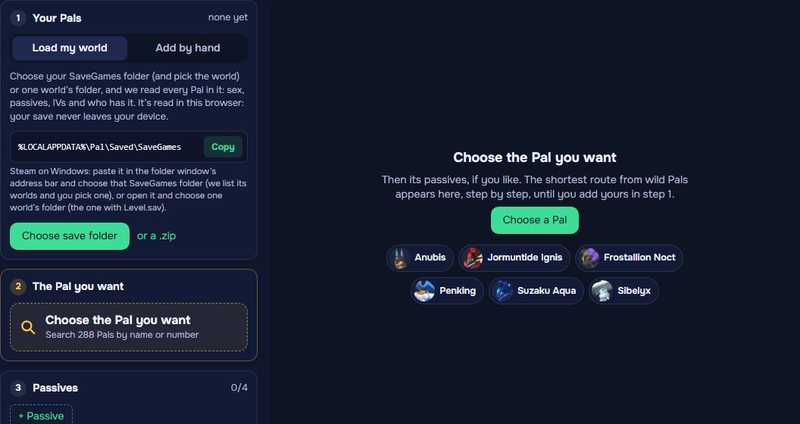
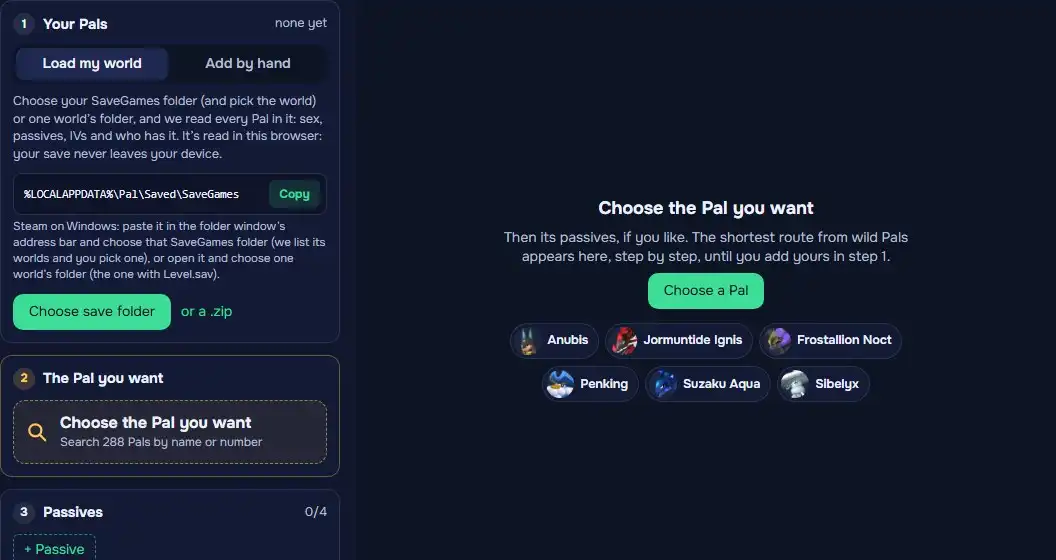
In step 1, Your Pals, keep Load my world open and click Copy next to
%LOCALAPPDATA%\Pal\Saved\SaveGames(Steam on Windows).Click Choose save folder. In the folder window, paste the path in the address bar, press Enter and choose that SaveGames folder. You can also open it and choose one world’s folder (the one with Level.sav), or click or a .zip to pick a .zip of either.
Your browser may ask whether to “upload” the files. That is its word for letting the page read them: the save is read on your device and never leaves it.
Step 2: Choose your world
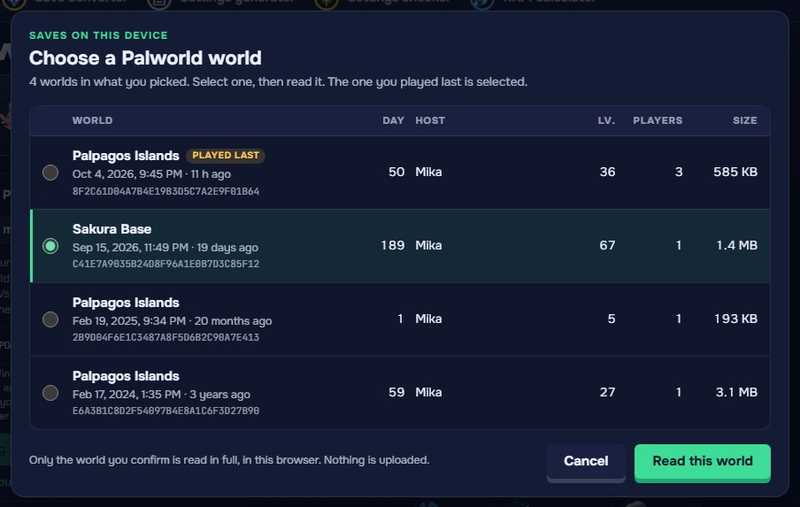
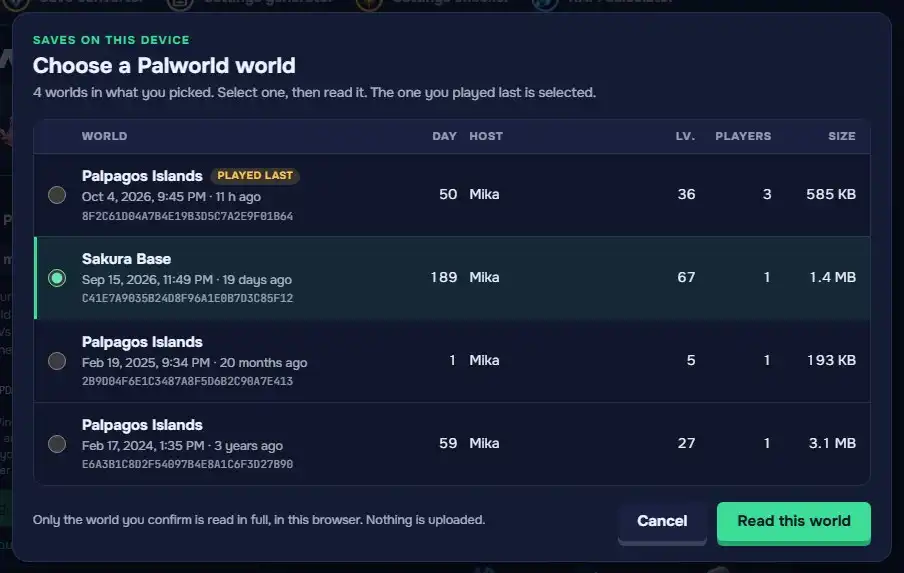
When the folder holds several worlds, you get a list with each world’s name, in-game day, host, host level, players and size, last played first. Select yours and click Read this world.
Only the world you confirm is read in full, in your browser.
Step 3: Check what it read
The message says how many Pals it read, from how many players, with their passives and IVs. See your Pals lists them with their IVs and passives; when several people play in the world, Whose Pals plans from one player’s Pals only.
Not on Steam? Use Add by hand and add each Pal with its sex, passives and IVs.
Read it again after you play to pick up new Pals. This browser remembers the world for your next visit.

Step 4: Choose the Pal you want
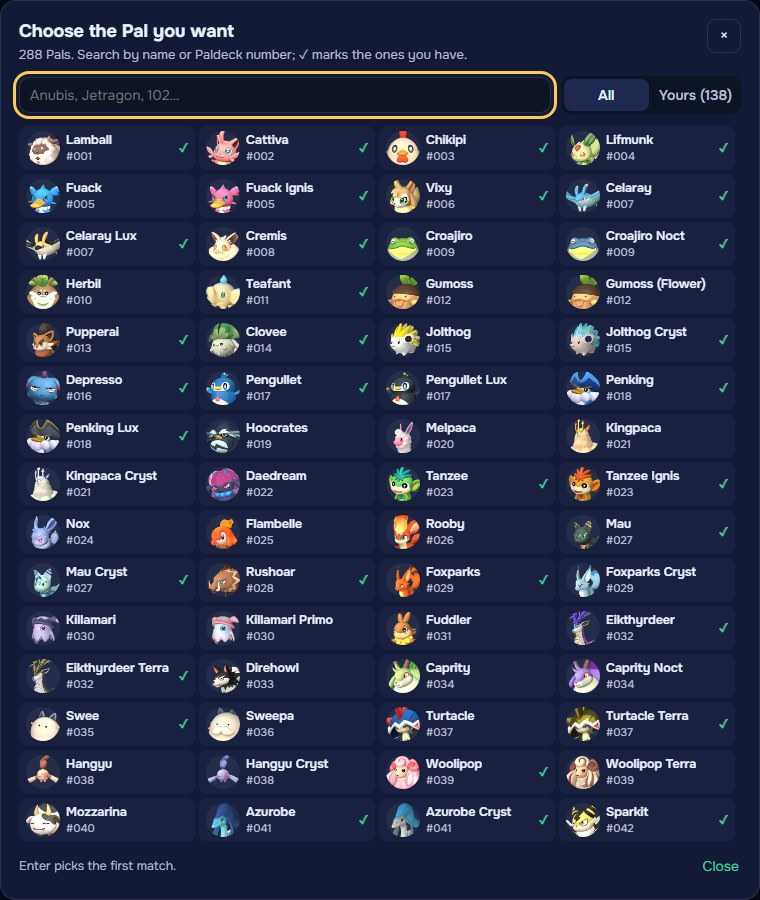
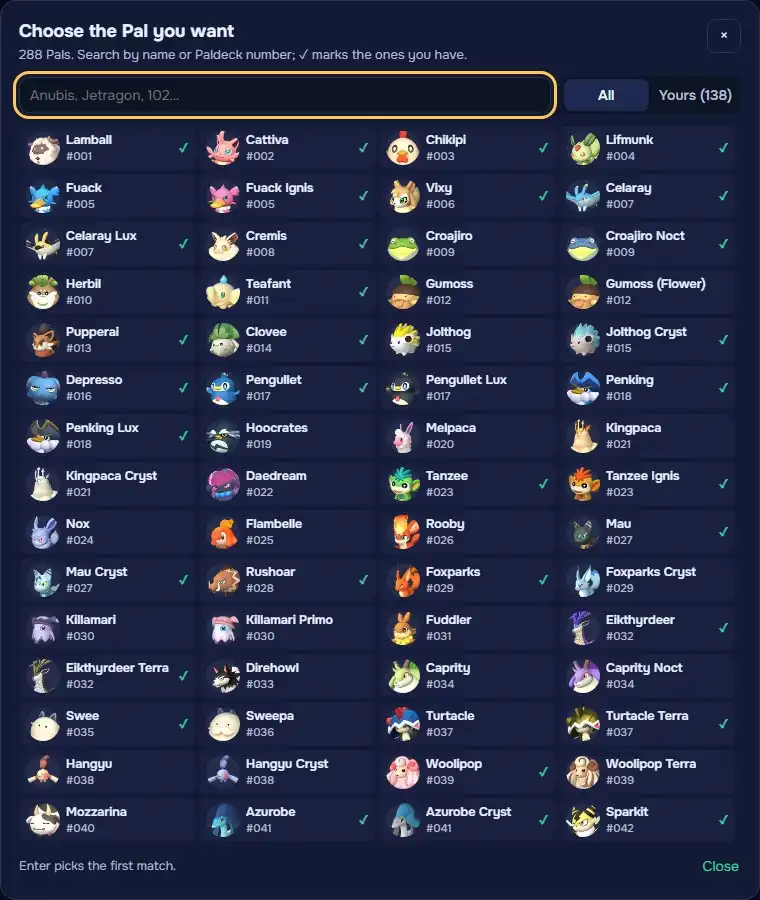
In step 2, click Choose the Pal you want. Type a name or Paldeck number and press Enter, or click a Pal. ✓ marks the ones you already have, and Yours shows only those.
Step 5: Add up to four passives
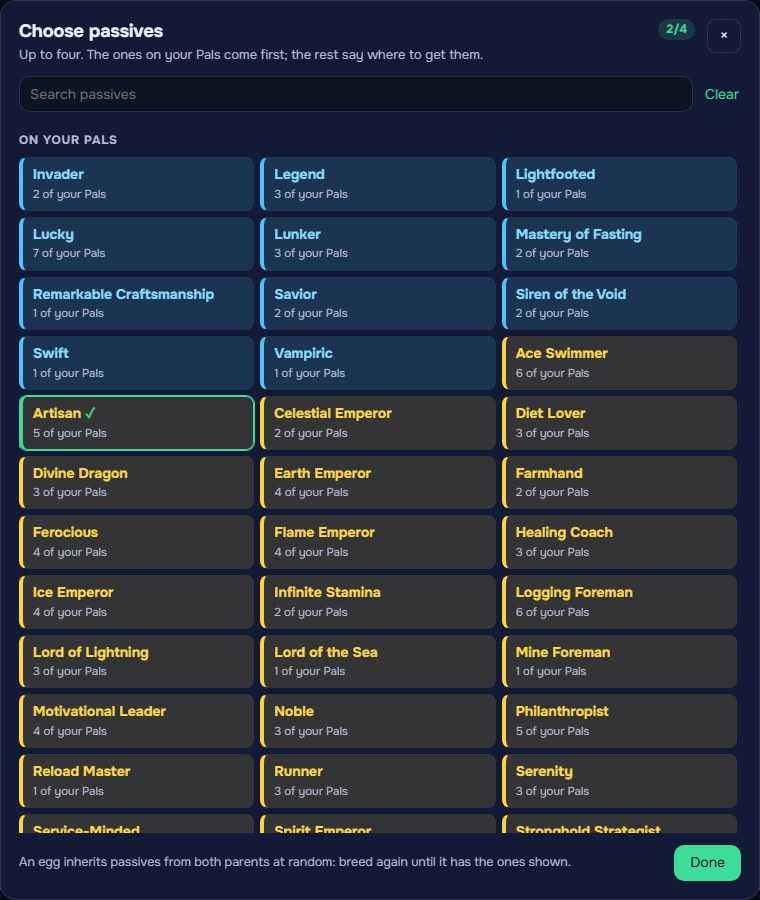
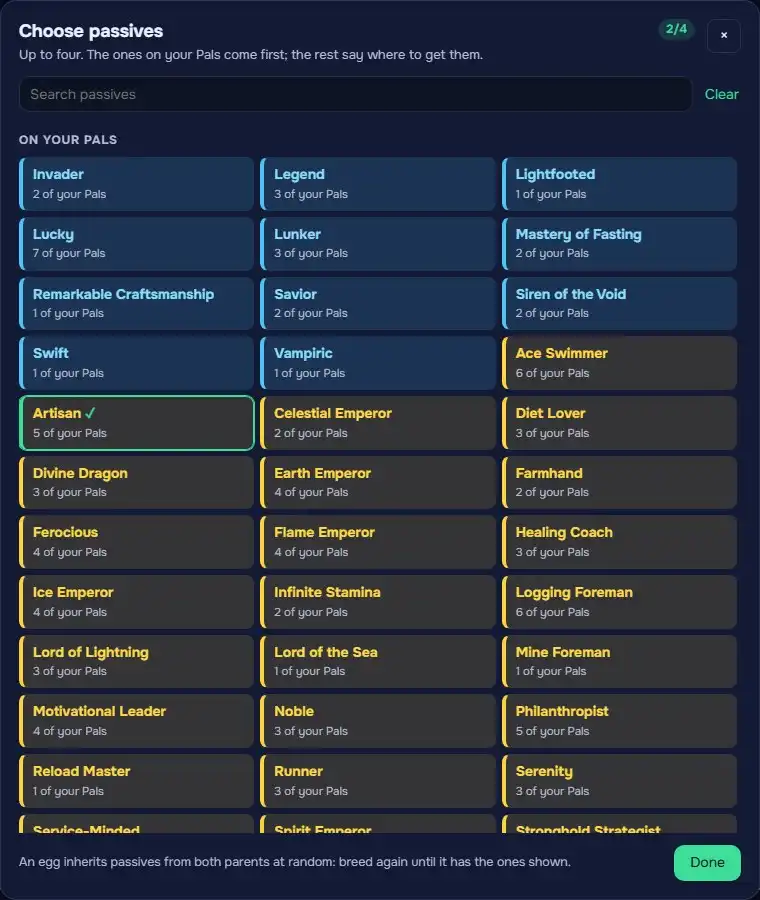
In step 3, click + Passive. The passives on your Pals come first, with how many of your Pals carry each one. The rest say where to get them: Pals always born with it, how rare it is on wild Pals, Lucky Pals, or a Disposable Implant at a Pal Surgery Table. Pick up to four, then Done.
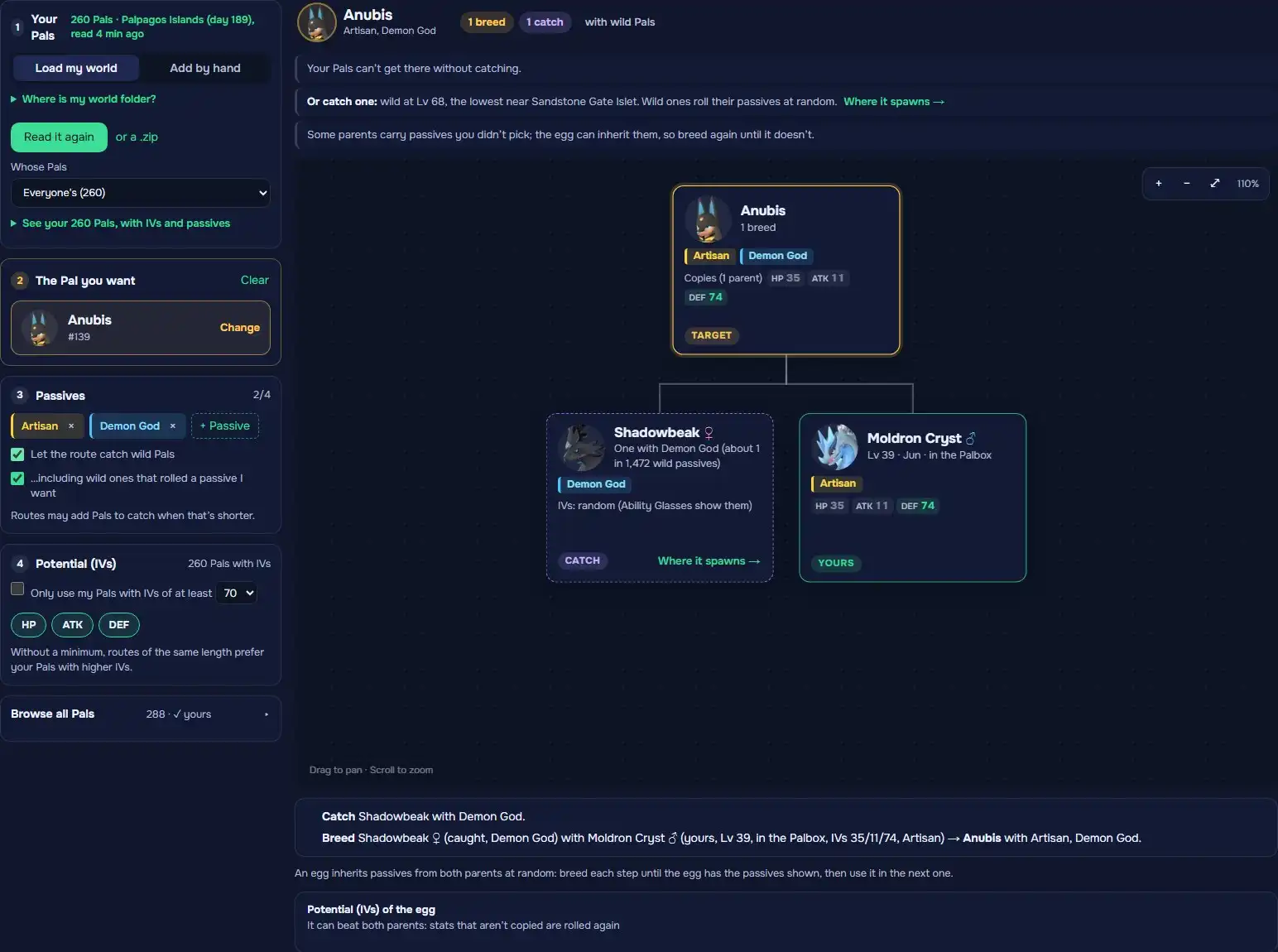
An egg inherits passives from both parents at random: breed each step until the egg has the passives shown.
Step 6: Read the route
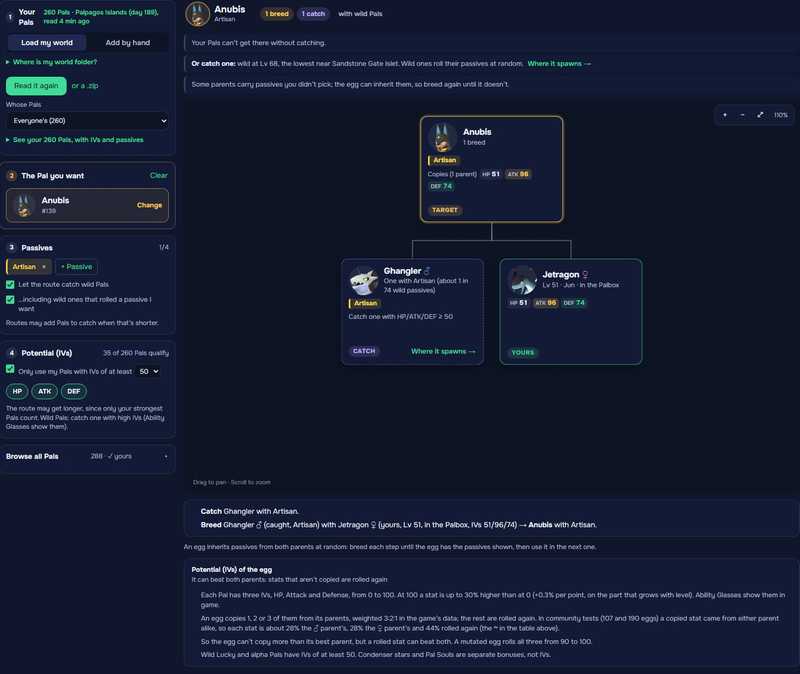
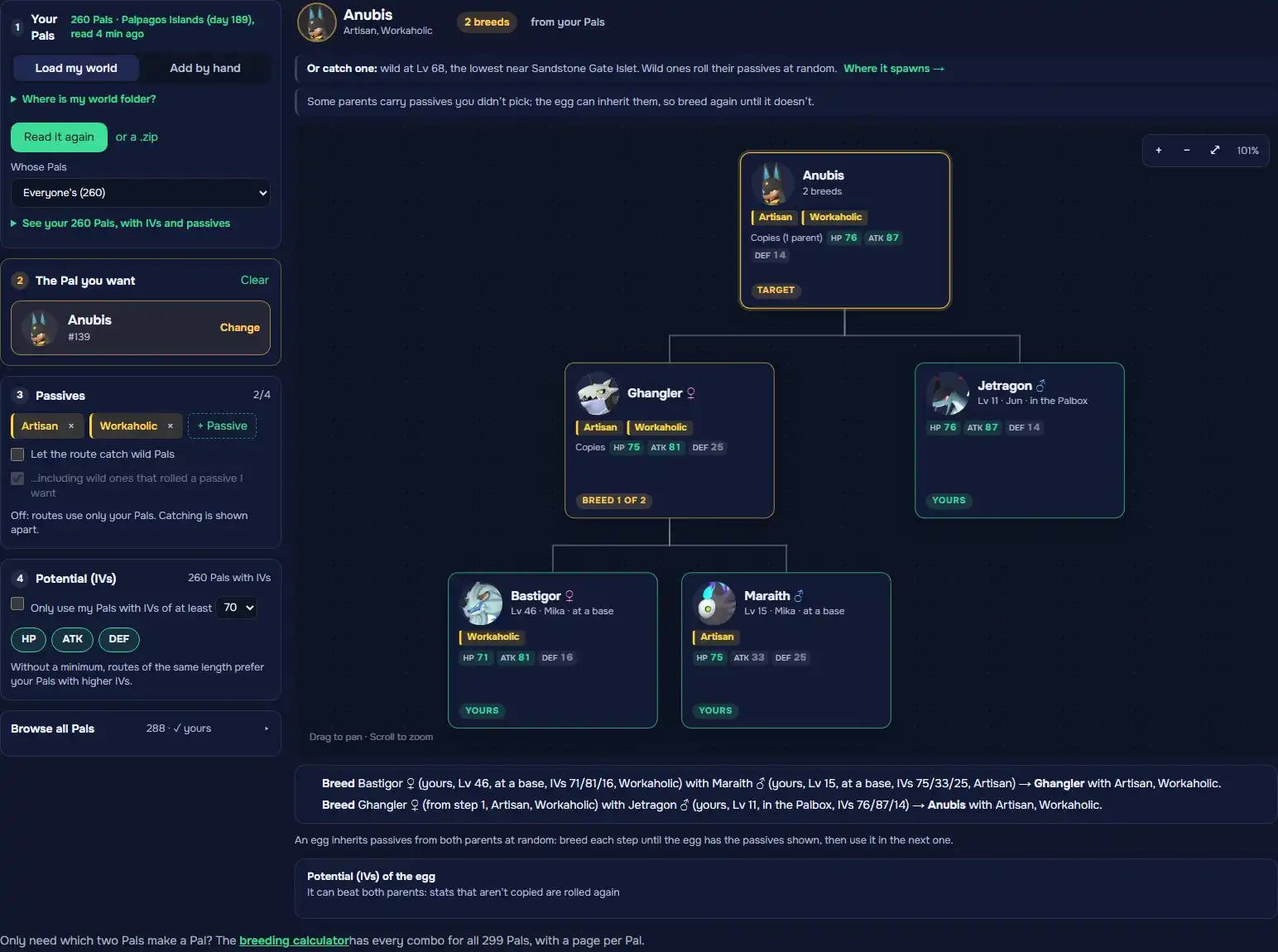
The route draws as a tree with your Pal at the top. Green cards are Pals you have, with owner, level and where they are; gold cards are breeds, in order (Breed 1 of 2…). Each card shows the passives it carries and its IVs. Under the tree, the same route is written out step by step.
Drag to pan, scroll to zoom, and ⤢ fits the whole route on screen.
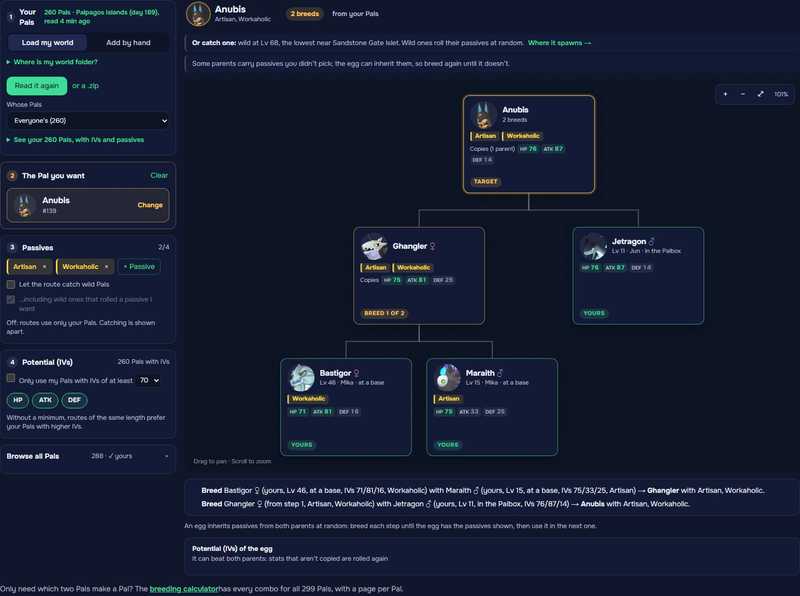
Step 7: Count the eggs, pick a cake
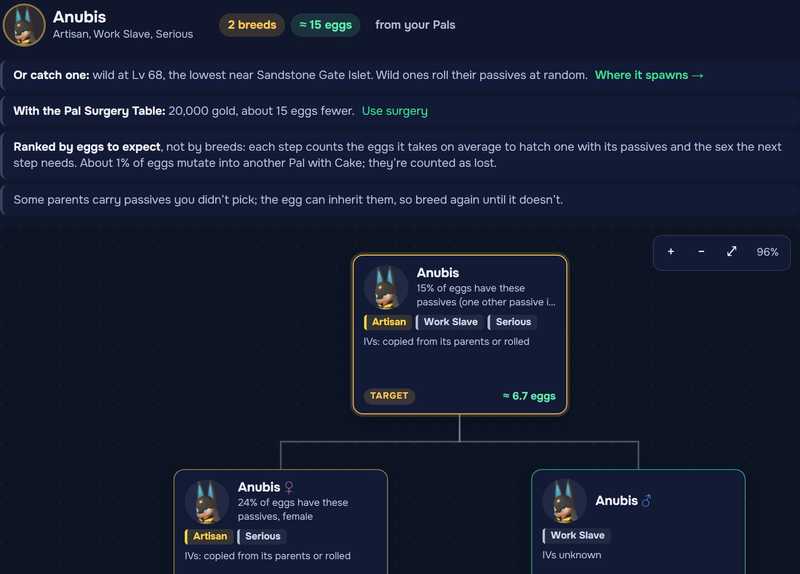
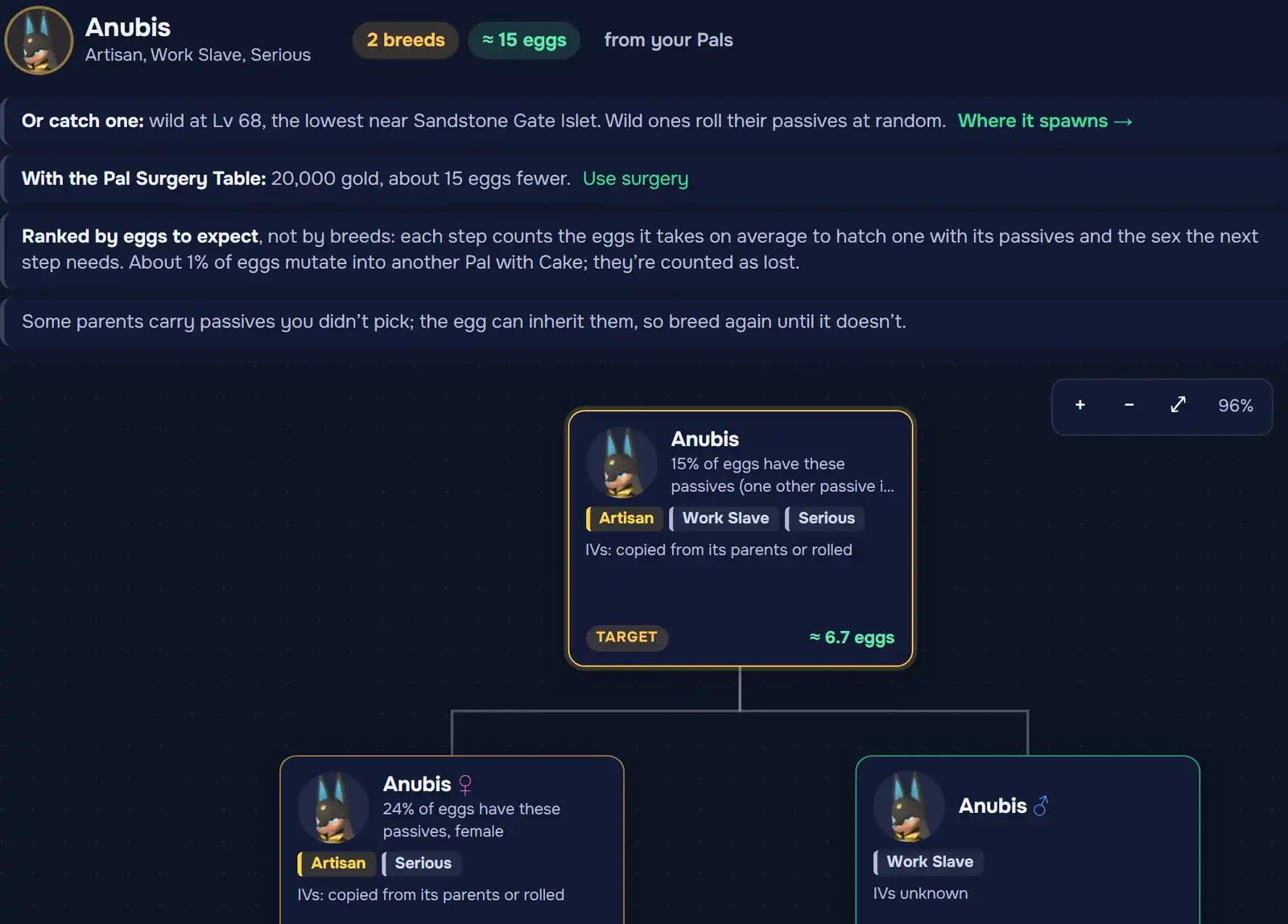
Each breed shows the eggs it takes on average: how often an egg gets its passives from those parents, with at most one other, and the sex the next step needs. The header adds them up. Routes are ranked by those eggs, so clean parents win even when they take a breed more; in step 5, Fewest breeds switches back to the shortest chain.
Step 5 also picks the cake: Special Cake makes every egg inherit four parent passives, and Vegetable Cake makes two eggs per cake.
The counts are averages: a lucky first egg is as possible as a long run.
Step 8: Breed it or implant it
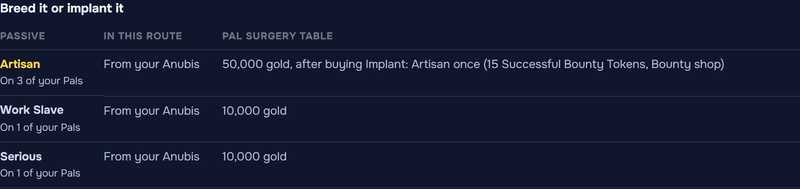
Tick Let the Pal Surgery Table add passives and the route adds them to the finished Pal for gold when that saves eggs. Disposable Implants you have can be ticked too. A note compares the route with and without surgery.
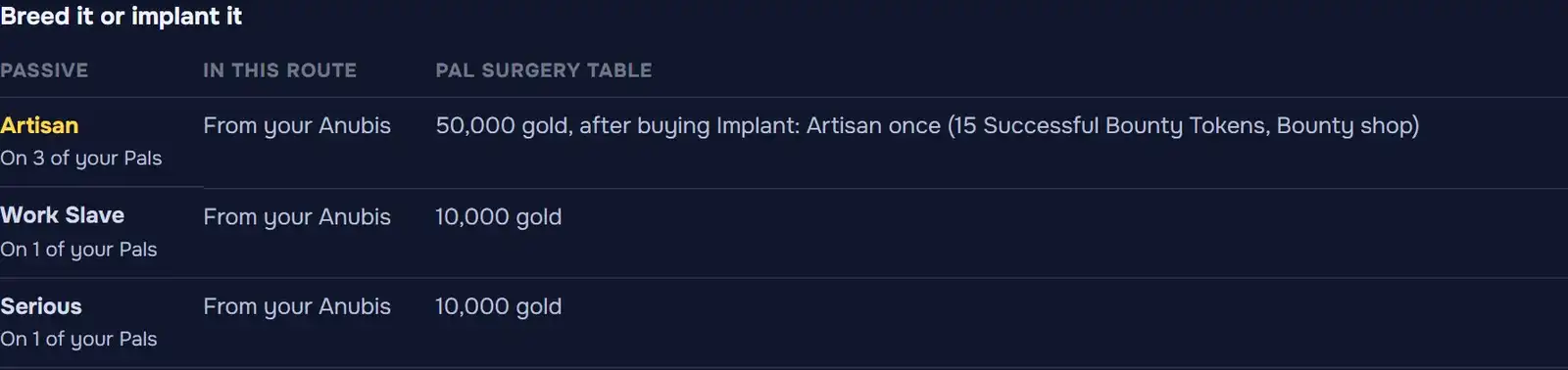
Under the route, Breed it or implant it shows each passive: which of your Pals has it, where the route gets it, and what surgery costs, with the Implant to buy first at the Arena or Bounty shop.
Step 9: Let it catch wild Pals
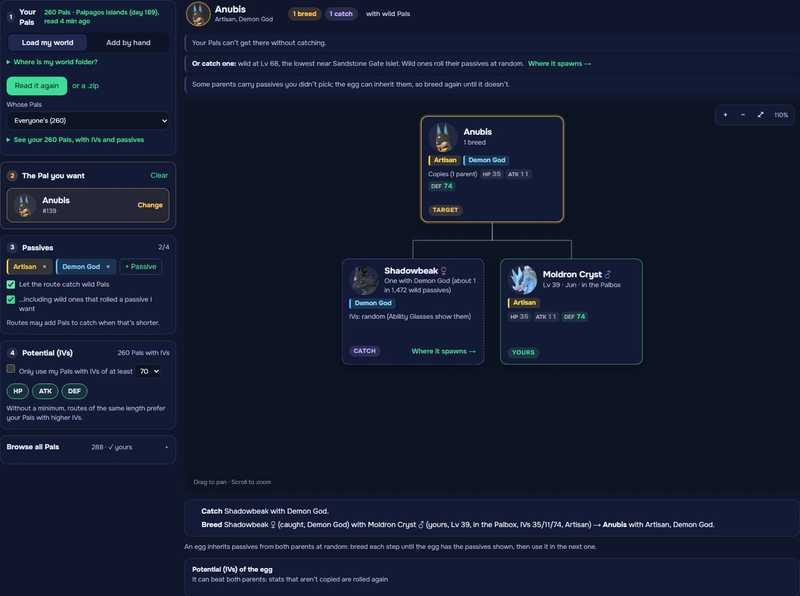
When none of your Pals has a passive, or catching is shorter, tick Let the route catch wild Pals. Purple dashed cards are Pals to catch, with the passive to look for and how rare it is; Where it spawns opens the map on that Pal.
With it off, the route uses only your Pals and shows catching apart.
Step 10: Breed for better IVs
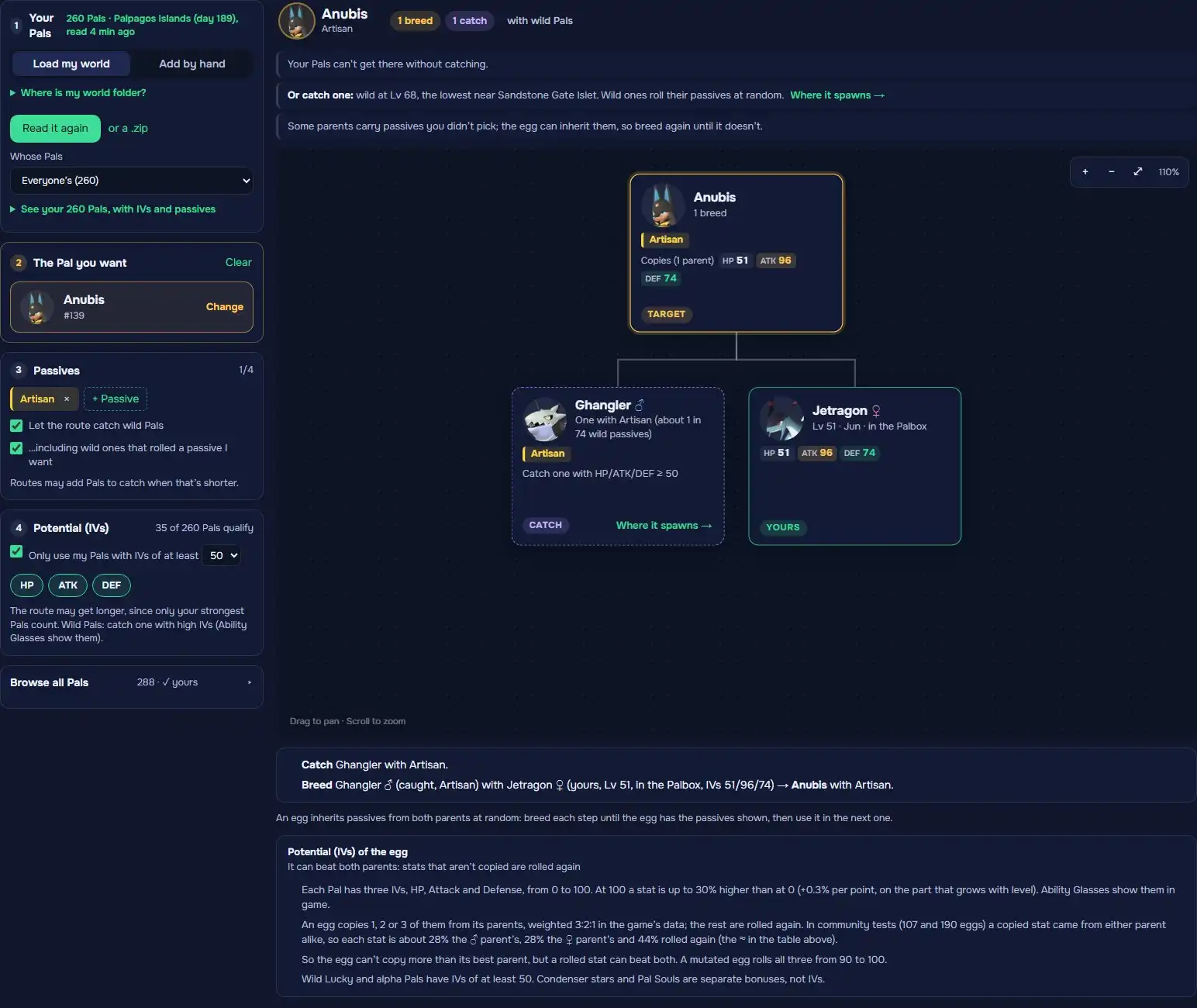
In step 4, Potential (IVs), tick Only use my Pals with IVs of at least, pick 50 to 90 and the stats that count. The route then uses only your strongest Pals, even if it gets longer, and asks for wild Pals with high IVs.
Potential (IVs) of the egg, under the route, explains what the egg can copy from its parents.
An egg copies 1 to 3 of its parents’ IVs and rolls the rest again, so a rolled stat can beat both parents.

That’s the whole loop
Load your world, pick a Pal and its passives, and follow the route. After you play, read your world again: the route starts from your new Pals.
Start breeding